Lake Forest Home Prices 2026: Why Median and Average Split
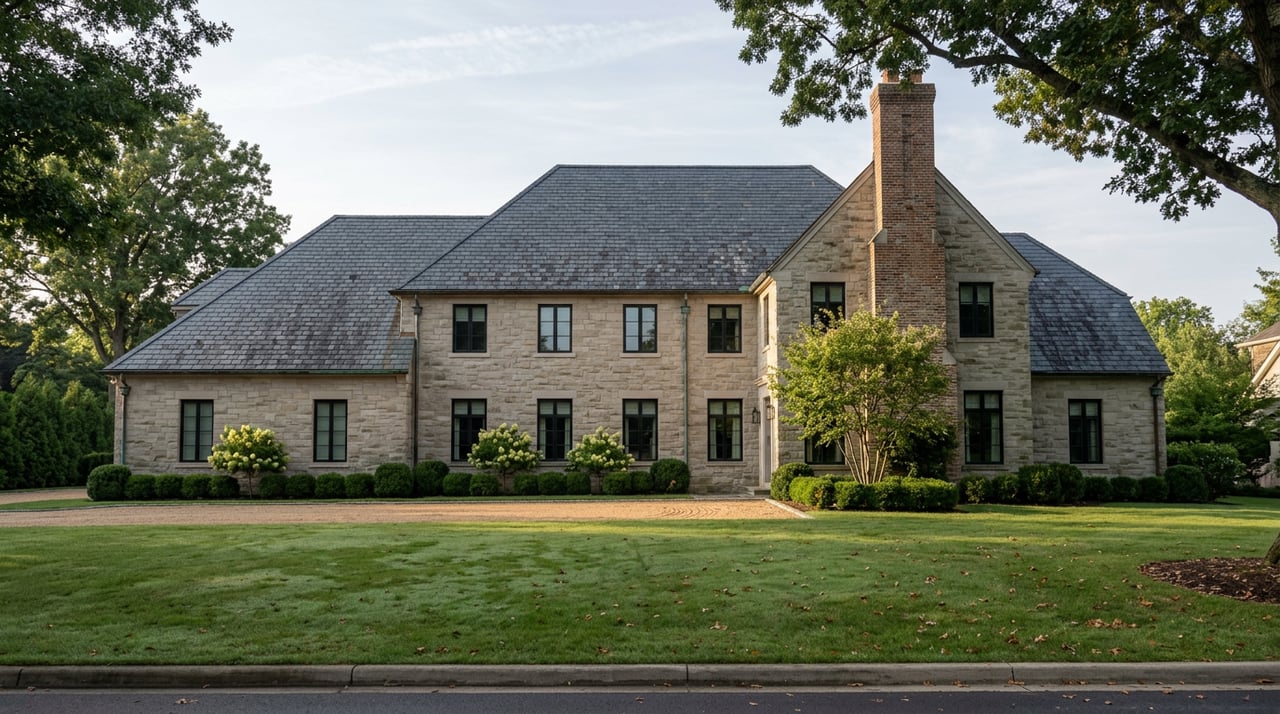
If you pulled up Lake Forest's home price numbers in March 2026, you'd have seen two headlines that shouldn't both be true. The median sale price was basically flat compared to a year earlier. The average sale price was up more than 7 percent over the same stretch. Same town, same month, same pool of closed sales. Two numbers moving in different directions.
Neither one is wrong. That's the part worth sitting with if you're trying to figure out what a home in Lake Forest actually costs right now, or what yours might sell for.
According to Midwest Real Estate Data (MRED), the multiple listing service that tracks closed sales across the Chicago region, Lake Forest's median sale price in March 2026 came in at $1.315 million, essentially unchanged from a year earlier. Over that same period, the average sale price climbed to $1.797 million, a jump of about 7.2 percent.
A median and an average measuring the same market a year apart shouldn't drift half a million dollars apart in opposite directions unless something underneath the data changed. What changed wasn't the value of a typical Lake Forest house. What changed was which houses happened to close escrow that month.
This is the part a raw stat sheet never explains, and it's the same statistical trick that trips up buyers comparing Naperville to Winnetka, or investors reading national housing indexes: when a market has a wide spread between its cheapest and most expensive properties, a handful of sales at the top can drag the average upward without moving the middle at all. The median tells you what the typical transaction looked like. The average tells you where the money went. In Lake Forest this spring, those were two different stories.
Part of that story has a name and an address. In March 2026, a Lake Forest mansion set on a bluff above Lake Michigan, complete with its own beach house at the base of the bluff, sold for $8.3 million, according to Crain's Chicago Business. Crain's reported it as the highest Chicago-area home price recorded so far in 2026.
A single sale like that doesn't move a median, because a median only cares about the house in the middle of the pack, not the house at the top of it. But it does move an average, and when several trophy-tier properties close in the same window, that's exactly the kind of quarter that produces a 7 percent average-price jump alongside a flat median. Lake Forest's luxury tier, generally understood as homes priced from roughly $3 million to $8 million, had its strongest quarter on record in the first quarter of 2026, with several properties selling above asking after competing offers. That's a genuinely different market than the one most buyers are shopping in, and it's the one quietly inflating the town's average.
Here's the part that matters most if you're comparing Lake Forest to another North Shore town, or trying to decide where inside Lake Forest to focus your search. A single citywide number can't describe a town built out of genuinely distinct pockets, each with its own price behavior.
| Area | Character | What Recent Data Shows |
|---|---|---|
| Conway Farms | Newer construction, golf-course and open-space lots | Median sale price of $1,088,500 in March 2026, with active inventory ranging from an $850,000 townhome to a $3.695 million estate on 2.18 acres |
| East Lake Forest | Historic district, walkable to downtown | A 1.82-acre parcel sold largely on its walk-to-town location; a home built in 2021 on East Illinois Road traded at $2.895 million within the historic district |
| Deerpath and Deerpath Hill Estates | Older housing stock, mostly built between the 1920s and 1960s | Character-driven inventory that tends to price below the town's newer-construction pockets |
| West Lake Forest | Larger lots, established luxury homes | Prices generally in the $1.35 million range, on lots running from a quarter acre to more than three acres |
| Old Elm Estates | Established, mature-lot enclave | A distinct pocket within the broader West Lake Forest luxury tier |
Look at that spread. Conway Farms alone contains a $850,000 townhome and a $3.695 million estate under the same neighborhood name. That's not a typo. It's what happens when a submarket includes both newer attached product and large custom-built lots. A buyer using Lake Forest's citywide median as a budget anchor could be off by hundreds of thousands of dollars depending on which of these pockets they're actually shopping in.
Price isn't the only place where Lake Forest's headline numbers hide a split market. Time on market tells a similar story, and it's arguably more useful if you're the one selling.
Across all price points, Lake Forest homes were sitting on the market for a median of roughly 84 days in early February 2026, based on Altos Research tracking for the 60045 zip code. But that citywide figure blends two very different selling experiences. Well-prepared, well-priced mid-market estates have generally been moving in one to three months. Properties at the very top of the price ladder, the $5 million-plus trophy listings, have in some cases taken many months longer to find a buyer, simply because the pool of people who can and want to write that check is small.
If you're pricing a home for sale in Lake Forest this year, the citywide days-on-market median tells you almost nothing about how long your specific listing should take. What matters is where your house sits on that spectrum, and whether your pricing strategy accounts for the fact that a $1.4 million well-prepared estate and a $6 million bluff property are, in practical terms, competing in entirely separate races.
If you're weighing Lake Forest against Winnetka, Glencoe, or Lake Bluff using a single median price per town, you're comparing a median that blends five distinct submarkets in Lake Forest with a median reflecting whatever mix happened to close in those other towns that same month. That's not really an apples-to-apples comparison. It's a median-to-median comparison, and as this spring showed, averages and medians in a town with this much price dispersion don't always agree with each other, let alone with a neighboring town's numbers.
The more useful question isn't "what's the median in Lake Forest?" It's "what's the median in the pocket of Lake Forest I'm actually looking at, and how does that compare to the same slice of inventory somewhere else?" Conway Farms against a comparable newer-construction pocket in Northbrook. East Lake Forest's walkable historic stock against Winnetka's downtown core. That's the comparison that actually informs a decision.
Is Lake Forest's luxury market representative of the whole town? No. The $3 million to $8 million tier set records in the first quarter of 2026, but that segment sits well above the town's overall median and shouldn't be used as a stand-in for what a typical Lake Forest home costs.
If the median was flat, does that mean prices aren't rising? Not necessarily. It means the typical transaction didn't move much year over year. It doesn't rule out real appreciation happening within specific submarkets or specific price bands, which the citywide median can mask just as easily as it can mask a mix-driven spike.
Does a long days-on-market figure mean a house is overpriced? Sometimes, but not always in Lake Forest. Because trophy-tier properties naturally take longer to sell due to a smaller buyer pool, a listing sitting for four or five months at the very top of the market isn't automatically a red flag the way it would be for a mid-market home priced correctly and still unsold after that long.
Lake Forest's numbers this year are a reminder that a single citywide statistic, whether it's a median, an average, or a days-on-market figure, is a starting point, not an answer. The real story is in the submarket, the price band, and the specific comparable sales around the property you're actually looking at or listing.
If you're trying to make sense of where your Lake Forest home, or the one you're considering, actually sits within this spread, that's exactly the kind of read The Wexler Gault Group works through with clients every week. Reach out for a Complimentary Home Consultation and we'll walk through what the current data means for your specific address, not just the town-wide headline.
CONTACT THE WEXLER GAULT GROUP
THE WEXLER GAULT GROUP
1741 2nd Street Highland Park, IL 60035